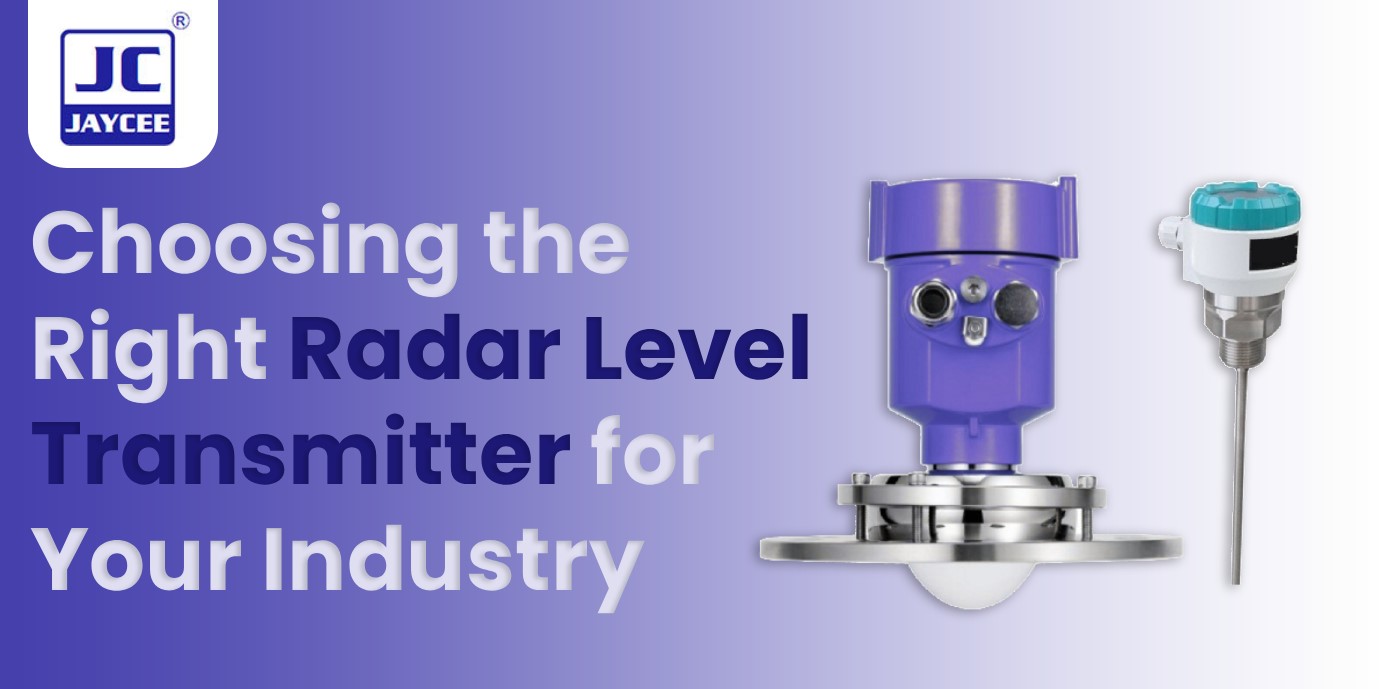
Selecting the right Radar Level Transmitter is one of the most important decisions for industries that rely on accurate and continuous level measurement. Whether you work in chemical processing, oil & gas, water treatment, food & beverage, pharmaceuticals, power plants, or manufacturing, choosing the wrong level transmitter can lead to inaccurate readings, production downtime, product wastage, and increased maintenance costs.
Unlike traditional level sensors, radar level transmitters use high-frequency electromagnetic waves to measure the level of liquids and solids without making direct contact with the material. This makes them highly reliable, accurate, and suitable for harsh industrial environments.
In this comprehensive guide, we'll explain how radar level transmitters work, the factors to consider before buying one, different types available, industry-specific recommendations, and common mistakes to avoid.
A Radar Level Transmitter is a non-contact or guided-contact level measurement device that uses microwave radar signals to determine the distance between the sensor and the surface of a liquid or solid material.
The transmitter sends microwave pulses toward the product surface. These signals reflect back to the sensor, and the time taken for the signal to return is converted into an accurate level measurement.
Because radar technology is unaffected by temperature, pressure, dust, steam, foam, or vapor, it delivers highly accurate and reliable measurements even in challenging industrial conditions.
Every industry has unique process requirements. A transmitter that performs well in a water treatment plant may not be suitable for a chemical storage tank.
Selecting the correct transmitter ensures:
Investing in the right solution can significantly improve operational efficiency while lowering long-term operating costs.
Start by identifying what needs to be measured.
Different applications include:
Some materials have smooth reflective surfaces, while others absorb radar signals differently. The transmitter should be selected based on the material's dielectric constant.
Non-Contact Radar
Ideal for:
Advantages:
Guided Wave Radar (Contact Type)
Best for:
Advantages:
Tank height directly affects transmitter selection.
Typical measuring ranges include:
| Tank Height | Recommended Radar |
|---|---|
| Up to 10 m | Standard Radar |
| 10–30 m | Medium Range Radar |
| Above 30 m | Long Range Radar |
Always choose a sensor with additional measuring margin beyond the maximum tank height.
Industrial environments vary significantly.
Typical operating temperatures:
Choose a transmitter designed for your operating temperature.
Some tanks operate under:
Ensure the transmitter is rated for the maximum process pressure.
One major advantage of radar technology is that it performs reliably in difficult conditions.
Radar transmitters work well in:
These conditions often cause problems for ultrasonic sensors.
Applications such as pharmaceuticals and chemicals require extremely accurate measurements.
Typical accuracy ranges:
Higher accuracy is recommended for inventory management and automated production.
Tank shape influences radar performance.
Common tank types include:
Internal structures such as mixers, ladders, or agitators should also be considered.
Different industries require different mounting styles.
Popular options include:
Select one that matches your existing tank design.
Modern industries rely on automation.
Look for transmitters supporting:
Compatibility with PLC, SCADA, and DCS systems is essential.
Requirements:
Recommended:
80 GHz Non-Contact Radar Level Transmitter
Requirements:
Recommended:
Long-range radar transmitter
Requirements:
Recommended:
Standard non-contact radar transmitter
Requirements:
Recommended:
Sanitary radar level transmitter
Requirements:
Recommended:
Guided Wave Radar Transmitter
Requirements:
Recommended:
High-power radar transmitter
When correctly selected, radar level transmitters provide:
Many industries purchase transmitters based solely on price rather than application needs.
Avoid these common mistakes:
For the best performance:
Before purchasing, ask these questions:
Answering these questions will help you choose a transmitter that delivers reliable performance and long-term value.
Choosing the right Radar Level Transmitter is about more than selecting a sensor—it’s about ensuring accurate level measurement, reducing maintenance, improving safety, and optimizing industrial operations. By evaluating factors such as material type, tank design, operating conditions, accuracy requirements, and communication protocols, businesses can invest in a solution that delivers dependable performance for years to come.
Whether your application is in chemical processing, oil & gas, pharmaceuticals, food manufacturing, water treatment, or bulk solids handling, the right radar level transmitter can enhance productivity, minimize downtime, and support smarter process automation.
A Radar Level Transmitter is an instrument that uses microwave radar signals to continuously measure the level of liquids or solids in tanks, silos, and vessels without direct contact with the material.
They are widely used in chemical plants, oil & gas, food and beverage, pharmaceuticals, water and wastewater treatment, power generation, mining, cement, and manufacturing industries.
Non-contact radar measures level using microwave signals through air, making it ideal for corrosive or hygienic applications. Guided wave radar uses a probe to guide the signal, offering excellent accuracy in smaller tanks and challenging conditions.
Yes. Depending on the model and application, radar level transmitters can accurately measure liquids, powders, granules, and other bulk solids.
Yes. Many industrial models are designed to operate reliably in extreme temperatures, high-pressure vessels, and hazardous environments.
Modern radar level transmitters can provide accuracy from ±10 mm down to ±1 mm, depending on the technology and application.
Consider the material being measured, tank size, temperature, pressure, measuring range, presence of steam or foam, required accuracy, mounting type, and communication protocol.
They require minimal maintenance because they have no moving parts. Periodic inspections and cleaning of the antenna or probe help ensure long-term accuracy.
Yes. Most models support industrial communication protocols such as 4–20 mA, HART, Modbus, Profibus, or Foundation Fieldbus for seamless integration.
Radar signals are less affected by dust, steam, foam, condensation, or temperature changes, making them more reliable than ultrasonic sensors in demanding industrial applications.
