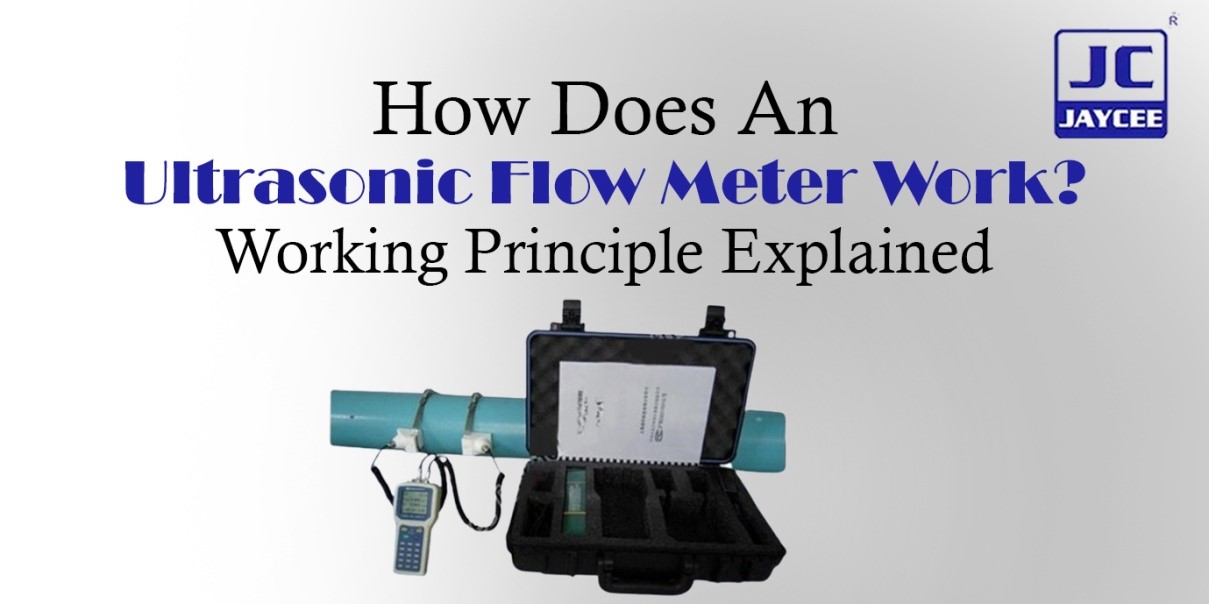
In today’s rapidly changing industrial environment of 2026, accuracy in fluid management is no longer a choice but a necessity. As the industries shift towards smarter and non-invasive flow monitoring systems, the Ultrasonic Flow Meter has become one of the most sought-after devices for the measurement of liquid velocity without cutting the pipe.
For process engineers and plant managers, the end goal is always to ensure that the system remains intact and provides accurate information. By adopting advanced ultrasonic technology from a reliable source such as Jaycee Tech, you can rest assured that your water treatment, chemical, or oil and gas plant is equipped with a maintenance-free and highly accurate flow measurement system.
An Ultrasonic Flow Meter is a high-tech instrument that employs sound waves to measure the flow rate of a liquid in a closed pipe. Unlike conventional flow meters, these instruments do not have any moving parts that can wear out or interfere with the flow. The basic components of these high-tech instruments are:
To understand the versatility of this technology, let’s break down the two primary methods an Ultrasonic Flow Meter uses to analyze fluid motion.
This is the most popular technique in 2026. Two transducers are mounted on the pipe. One transmits a signal downstream, and the other transmits a signal upstream.
For fluids with solids or air bubbles, the Doppler principle is employed.
In 2026, Jaycee Tech meters employ sophisticated DSP (Digital Signal Processing) to eliminate industrial noise and vibration, thus ensuring that the "pulse" of the sound wave is not obscured.
Since the sound wave passes through the pipe wall, the sensors are merely clamped to the outside. No need to shut down the plant, cut pipes, or be concerned about pressure drops.
The new paradigm of "Industrial IoT" and efficient manufacturing has set new standards for flow measurement.
Conventional flow measurement (Orifice or Venturi) involves a restriction in the pipe, which increases the workload of the pumps. Ultrasonic flow measurement is non-restrictive and involves zero pressure drop—a key requirement for the sustainability agenda of 2026.
In the pharmaceutical and food industries, contamination is a major concern. Since the ultrasonic transducers do not come into contact with the fluid, there is zero chance of contamination or chemical corrosion of the sensor.
Jaycee Tech flow measurement instruments come equipped with diagnostic capabilities. In 2026, these instruments can sense changes in "signal strength" that could be an indication of scale formation within the pipe, allowing for preventive maintenance before the flow is reduced.
While procuring your equipment, make sure your vendor adheres to the following 2026 industrial specifications:
At Jaycee Tech, we fill the gap between the complex physics of flow and the need for simple, intuitive instrumentation. Here’s why we are the best in the business for industrial automation and flow solutions:
The Ultrasonic Flow Meter is the best solution for the smart factory of 2026. It provides a lower Total Cost of Ownership (TCO) compared to almost all other flow technologies because it doesn’t require pipe cutting and doesn’t have any mechanical parts that can wear out. When you choose a specialist like Jaycee Tech, you can be assured that your fluid measurement is accurate, reliable, and future-ready.
Yes! As long as the liner is strongly attached to the pipe wall (no air pockets), the ultrasonic wave can travel through to the fluid.
Although they have no moving parts to fail, most quality specifications recommend a verification or "dry-calibration" test every year to verify electronic integrity.
Typically, clamp-on flow meters are best suited for pipes 1/2 inch (15 mm) and larger. For very small fluid lines, inline ultrasonic probes are employed.
No. To obtain accurate measurements, the pipe must be completely filled with fluid to provide a direct path for the ultrasonic wave from one side of the pipe to the other.
