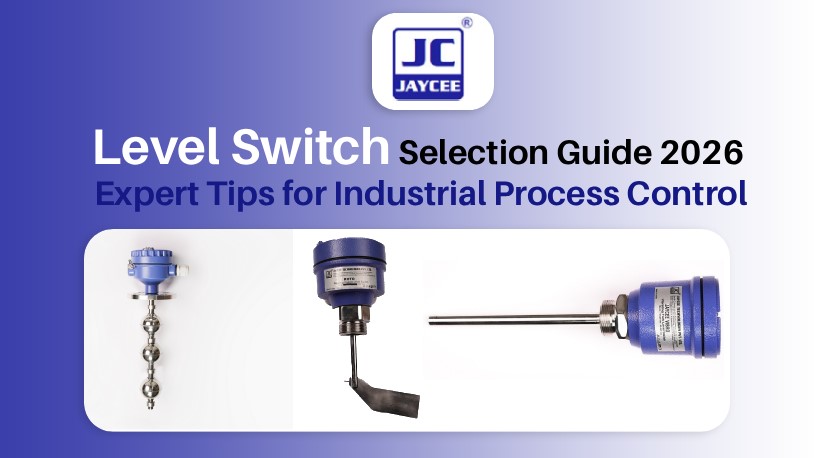
In contemporary industrial process control, accuracy and safety are paramount. Automation ecosystems are increasingly reliant on real-time data edge architecture, making point level measurement a vital asset. A single unscheduled shutdown triggered by a failed overflow or a dry-running pump can cost an industrial facility upwards of $22,000 per hour in lost productivity, equipment degradation, and regulatory penalties. Consequently, choosing the correct instrumentation is a core mandate for instrumentation engineers, automation professionals, and process operators worldwide.
As we navigate 2026, industrial process plants are shifting away from manual operations toward high-reliability, autonomous control networks. Level switches serve as the definitive baseline security layer within these systems, acting as primary high-level alarms, low-level interlocks, and critical components of Safety Instrumented Systems (SIS). This comprehensive selection guide bridges the gap between fundamental instrument physics and cutting-edge operational technology, offering an uncompromised framework to optimize system reliability and minimize lifetime cost of ownership.
A level switch is an industrial instrumentation device designed to detect the presence or absence of a process medium (liquid, slurry, granule, or powder) at a specific pre-determined height within a vessel, silo, or piping network, transmitting a discrete electrical binary output (ON/OFF) to a control loop or Safety Instrumented System (SIS) to prevent overfills, dry running, or process deviations.
Unlike continuous level sensors that track inventory across a dynamic spectrum (e.g., 0% to 100%), point level switches operate deterministically. They respond to a specific threshold boundary. Upon reaching this boundary, the physical or electrical property changes across the sensing element, causing the internal circuitry to trip an electrical output. This signal typically communicates directly with a Programmable Logic Controller (PLC), Distributed Control System (DCS), or emergency shutdown matrix via wired relays, digital protocols, or wireless networks.
Selecting the ideal instrument requires an objective understanding of the underlying physics governing each technology. Here, we analyze the most prominent industrial level switch topologies deployed in modern process environments.
Vibrating level switches utilize a piezo-electric crystal pair to drive a metal tuning fork at its natural resonant frequency in free air. When the process medium submerses the fork, the frequency drops and the amplitude decreases sharply. The internal microprocessor detects this shift and alters the relay output state.
Capacitance switches operate by treating the probe and the tank wall (or a reference ground electrode) as a two-plate capacitor. The intervening process medium serves as the dielectric material. As the material level rises, the electrical capacitance shifts proportionally. Advanced Radio Frequency (RF) Admittance switches build upon this by injecting a high-frequency RF signal and utilizing a guard circuit to separate the active capacitance from the resistance of material buildup on the probe.
A classic mechanical solution, these instruments rely on buoyancy. A float containing an internal permanent magnet moves vertically along a stem in response to liquid level changes. When the float nears an internal hermetically sealed reed switch, the magnetic field forces the contacts to close or open.
Ultrasonic level switches use a small crystal gaps layout. An electrical signal generates a high-frequency ultrasonic pulse that passes across a narrow sensing gap when liquid is present. If the gap is filled with gas, the acoustic wave cannot cross effectively. Optical variants operate similarly but utilize infrared light refraction within a prism tip to detect the difference between a gaseous and liquid medium.
The matrix below serves as a definitive cross-reference guide to align process media characteristics with the correct level switch technology to ensure optimal process control architecture.
| Process Medium Type | Primary Technology Recommendation | Alternative Option | Critical Selection Parameter |
|---|---|---|---|
|
Clean, Low-Viscosity Liquids (Water, Diesel, Solvents) |
Vibrating Tuning Fork | Magnetic Float Switch | Verify chemical compatibility with wetted metallurgy. |
|
Highly Viscous / Coating Slurries (Asphalt, Pulp, Wastewater) |
RF Admittance / Capacitance | Non-Contacting Radar (Point Config) | Incorporate active guard circuitry to mitigate severe buildup. |
|
Corrosive Acids / Alkalis (HCl, H2SO4, NaOH) |
Plastic/PTFE-Coated Tuning Fork | RF Admittance (PFA Lined) | Confirm zero-porosity lining integrity to protect core electronics. |
|
Bulk Solids & Fine Powders (Fly Ash, Cement, Grain) |
Rotary Paddle / Vibrating Rod | Capacitance Probe | Assess grain size, bulk density, and structural mechanical loading. |
|
Cryogenic Fluids (LN₂, LNG, Liquid Oxygen) |
Ultrasonic Gap Switch | Hydrostatic DP (Point Config) | Thermal isolation housing required for extended electronics lifetime. |
|
(LN2, LNG, Liquid Oxygen) |
For applications managing hazardous processes or environmental overspill protection, instruments must comply with IEC 61508 and IEC 61511 functional safety standards. SIL-2 and SIL-3 certified level switches feature high Diagnostic Coverage (DC) percentages and internal self-testing routines. These devices guarantee a low Probability of Failure on Demand (PFD), minimizing risks in critical process loops.
Industrial IoT (IIoT) Integration and Smart DiagnosticsModern instrumentation goes beyond plain dry contacts. Industrial switches now feature digital communication protocols like IO-Link, HART, and wireless architectures. These protocols enable proactive asset management. Instead of waiting for a total switch failure, an IO-Link connected tuning fork switch can send preventative warnings regarding sensor erosion, crystal degradation, or partial coating buildup. This allows teams to schedule target maintenance during planned turnarounds.
Follow this structured, five-step engineering protocol when executing your next instrumentation procurement process:
A point level switch monitors a singular, predefined height boundary to indicate whether material is present or absent (binary ON/OFF tracking). A continuous level sensor provides dynamic tracking across the entire height of a vessel, reporting real-time percentage or measurement fills (e.g., 4-20mA or digital scaling from 0% to 100%).
Standard tuning fork switches are inherently tuned to detect density changes. Light, airy process foam typically does not possess enough mass to dampen the tuning fork's high-frequency mechanical vibration, allowing it to ignore foam and accurately trip only when the true liquid phase submerses the sensor. However, dense, wet foams can cause pre-tripping, requiring adjustable sensitivity microprocessors.
Capacitance level switches rely directly on the process material acting as a dielectric insulator between the probe and the tank wall. Materials with a very low dielectric constant (such as organic solvents or hydrocarbons, $\varepsilon_r < 2$) generate subtle capacitance changes, demanding highly sensitive, calibrated RF instruments to prevent signal dropouts.
Deploying an RF Admittance switch with a dedicated driven shield or guard section is the industry standard approach. The guard section drives a high-frequency voltage in phase with the active sensor tip, neutralizing current leakage through any sticky coating material layer along the probe to the vessel wall, ensuring the switch only fires when true bulk material bridges the main process gap.
Selecting the right level switch is a foundational step toward achieving stable, safe, and highly efficient industrial process control. By matching the physical and chemical characteristics of your process media to the proper sensor technology—and accounting for key criteria like safety certifications, pressure boundaries, and advanced digital connectivity—you can mitigate the risks of costly false alarms and premature device failures. Instrumentation decisions should always balance upfront capital costs against the long-term operational savings of minimized maintenance and extended device lifetimes.
Ensure your facility's safety and operational efficiency with certified instrumentation tailored precisely to your application. Contact our expert applications engineering division today to receive a comprehensive, data-driven instrument audit for your plant infrastructure.
👉 [Request Expert Technical Consultation]