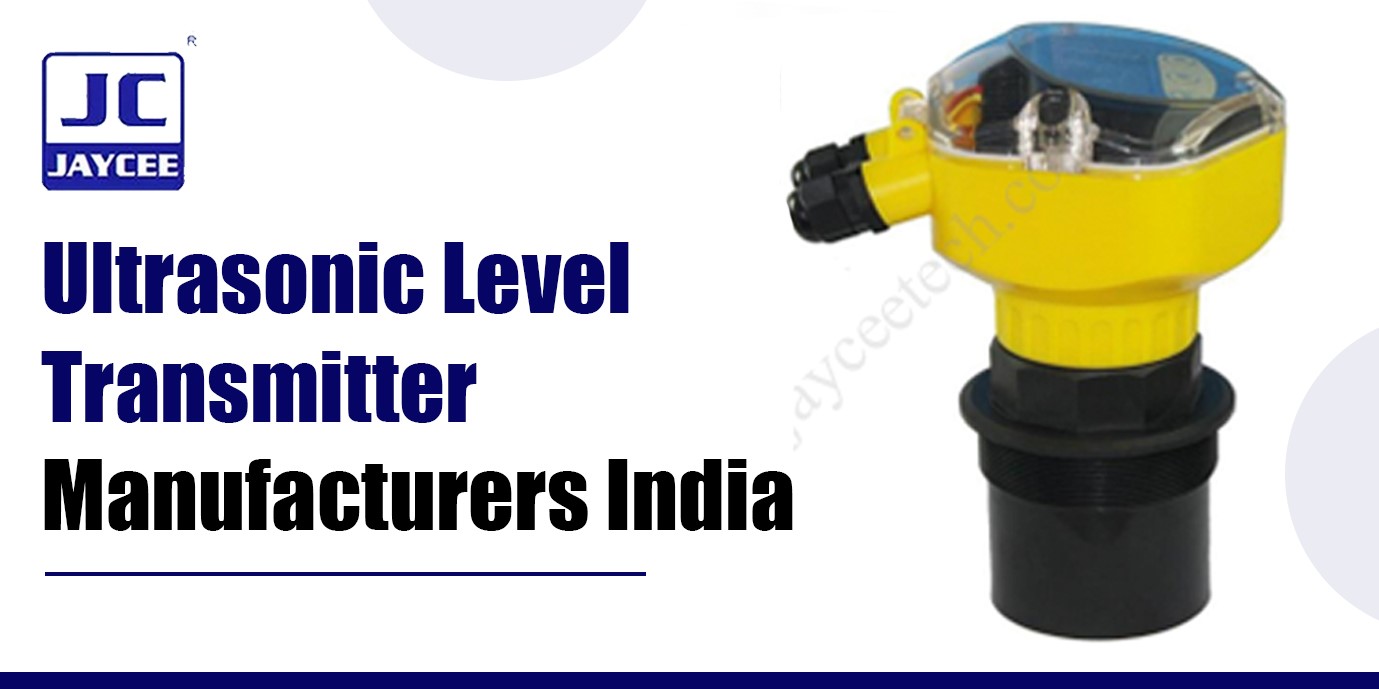
Accurate level measurement is essential for maintaining safe, efficient, and reliable industrial processes. Industries such as water and wastewater treatment, chemicals, pharmaceuticals, food processing, cement, power generation, mining, oil and fuel handling, and process manufacturing use level measurement instruments to monitor liquids and bulk materials.
Among the different level measurement technologies available today, ultrasonic level transmitters are widely used because they provide continuous, non-contact level measurement without requiring the sensing element to come into direct contact with the process material.
India has a growing ecosystem of instrumentation manufacturers and suppliers offering ultrasonic level transmitters for tanks, vessels, sumps, silos, open channels, wastewater systems, and other industrial applications.
This guide explains what an ultrasonic level transmitter is, how it works, its advantages and limitations, applications, important specifications, selection criteria, and what to look for when choosing an ultrasonic level transmitter manufacturer in India.
An ultrasonic level transmitter is an electronic measuring instrument used to continuously determine the level of a liquid or bulk material.
It normally works without physical contact with the material being measured. The transmitter sends ultrasonic sound waves toward the material surface. The waves reflect from the surface and return to the sensor.
The instrument measures the time taken for the ultrasonic signal to travel to the surface and return.
The measured distance is then converted into a level value.
In simple terms:
Ultrasonic pulse → Surface reflection → Echo received → Time measured → Distance calculated → Level displayed/output
Because the sensor does not normally touch the process medium, ultrasonic measurement can be useful for corrosive, dirty, contaminated, or wastewater applications where contact-based instruments may require additional maintenance.
The operating principle is based on time of flight.
The transmitter sends an ultrasonic pulse toward the surface of the material.
When the pulse reaches the surface, part of the energy is reflected back toward the transducer. The electronics detect the returning echo and calculate the distance between the sensor and the material surface.
A simplified relationship is:
Distance = Speed of Sound × Time ÷ 2
The division by two is required because the ultrasonic signal travels to the surface and then returns to the sensor.
The level can then be calculated from the known tank height:
Level = Reference/Tank Height − Measured Distance
Modern instruments can incorporate temperature compensation because the speed of sound changes with temperature.
Ultrasonic level transmitters offer several practical advantages for industrial level measurement.
The sensor can measure the level without being immersed in the liquid.
This is useful where the medium is corrosive, contaminated, dirty, or difficult to access.
Because there are generally no moving mechanical parts in the sensing path, maintenance requirements can be reduced compared with some mechanical level instruments.
Unlike a simple point-level switch, an ultrasonic transmitter can continuously measure the changing level.
The measurement can be integrated with PLC, SCADA, DCS, indicators, controllers, or other automation systems depending on the model.
Ultrasonic transmitters can be used in applications involving:
The suitability depends on the material, vessel geometry, temperature, vapour, dust, foam, surface condition, measuring range, and instrument design.
Many ultrasonic transmitters are installed at the top of a tank or vessel.
This allows measurement without inserting a probe into the process material.
Different industrial applications require different transmitter configurations.
A two-wire transmitter uses a two-wire connection for power and signal transmission.
A common industrial output is 4–20 mA.
This configuration can be useful where the transmitter needs to communicate with conventional process-control systems.
Some manufacturers provide additional communication or configuration options depending on the product model.
Smart ultrasonic transmitters generally provide more advanced configuration, diagnostics, communication, and calibration capabilities.
Depending on the design, features may include:
For example, Jaycee Technologies describes ultrasonic models with 4–20 mA output, optional RS-485/relay functionality, temperature compensation, and digital configuration features.
In an integral design, the sensing element and electronics/display are combined into one unit.
This arrangement can simplify installation where the mounting location is easily accessible.
A split-type configuration separates the sensor from the display/electronics.
This can be useful when the sensor must be installed on a tank or vessel while the display or controller needs to be located in a more accessible or safer area.
Cirrus Engineering, for example, describes integral and split ultrasonic level transmitter configurations.
Ultrasonic level transmitters are used across many industries.
One of the most common applications is water and wastewater management.
Typical measurement points include:
Jaycee Technologies specifically lists water and wastewater treatment, pumping stations, collection wells, biochemical reaction tanks, and sedimentation tanks among its applications.
Ultrasonic level measurement can be used for suitable chemical storage and process vessels where non-contact measurement is desirable.
Typical considerations include:
For aggressive chemicals, the complete wetted/process environment and transmitter construction should be reviewed before selection.
Level measurement can be required for:
For hygienic or sanitary applications, the required materials, process connections, cleaning procedures, and applicable standards should be confirmed with the manufacturer.
Potential applications include:
The instrument configuration should be selected according to hygiene, temperature, cleaning, and process requirements.
Cement and mineral-processing plants often require level measurement for storage and process materials.
Depending on the material and environmental conditions, ultrasonic measurement may be considered for:
Dust and material characteristics should be evaluated carefully because airborne dust can influence ultrasonic signal quality.
Level measurement can support monitoring of:
Instrument selection should consider temperature, vapour, tank geometry, and the specific process.
Ultrasonic instruments can be used in suitable mining applications involving:
Jaycee Technologies lists electric power, mining mortar pools and coal slurry ponds among its ultrasonic level transmitter applications.
Tank level measurement is one of the most common uses of ultrasonic technology.
A typical installation places the transmitter at the top of the tank.
The instrument measures the distance from the sensor to the liquid surface and converts the measurement into a level value.
For example:
Tank height: 5 metres
Measured empty space: 2 metres
Approximate liquid level:
5 − 2 = 3 metres
The actual configuration must account for the transmitter's reference point, zero/span settings, dead zone, tank geometry, and installation conditions.
When comparing ultrasonic level transmitter manufacturers in India, do not compare manufacturers only by price.
Review the complete technical specification.
The transmitter should support the required tank or vessel height.
For example:
The available range varies by model and manufacturer.
Jaycee Technologies publishes models with measuring ranges up to 50 metres for certain ultrasonic transmitter configurations.
Accuracy indicates how closely the measured value corresponds to the actual level.
Different models may specify accuracy differently, so the manufacturer's complete specification should be reviewed.
For example, one Jaycee smart ultrasonic model page lists 0.2% accuracy, while another Jaycee configuration lists 3 mm typical accuracy. These specifications should not be treated as interchangeable because they refer to specific product configurations.
Common output options include:
4–20 mA
A 4–20 mA signal is widely used for industrial process instrumentation.
RS-485 / Modbus
Digital communication can allow integration with automation and monitoring systems where supported.
Relay Output
Some transmitters provide relay outputs for alarm or control functions.
Display
A built-in display can allow operators to view the measured level locally.
Both technologies provide non-contact level measurement, but they use different physical principles.
| Feature | Ultrasonic | Radar |
|---|---|---|
| Measurement principle | Sound waves | Electromagnetic waves |
| Contact with material | Normally non-contact | Non-contact |
| Effect of temperature | Can affect speed of sound | Generally much less dependent on atmospheric temperature |
| Vapour influence | Can be significant depending on conditions | Often better suited to vapour-heavy applications |
| Foam | Can affect measurement | Depends on foam characteristics and radar technology |
| Dust | Can interfere with ultrasonic signal | Radar may perform better in many dusty applications |
| Typical applications | Water, wastewater, tanks, open channels | Process vessels, challenging environments, liquids/solids |
| Selection | Depends strongly on environment | Depends strongly on process and radar type |
The correct choice depends on the actual application rather than simply choosing the newer or more advanced technology.
Pressure/hydrostatic level measurement determine level from the pressure generated by the liquid column.
Ultrasonic measurement determines the distance to the material surface.
Ultrasonic may be considered when:
Pressure measurement may be considered when:
Application-specific engineering is important before selecting the technology.
Ultrasonic measurement is reliable when properly applied, but certain conditions can affect the signal.
Choosing a manufacturer is not only about purchasing the instrument.
Consider the manufacturer's ability to understand the application and provide appropriate technical support.
Check whether the manufacturer has experience with the type of level measurement required for your industry.
A good supplier should provide clear information about:
The supplier should be able to discuss tank geometry, liquid characteristics, foam, vapour, temperature, installation position, and expected measurement performance.
Industrial applications may require customized:
Consider availability of:
India has several companies offering ultrasonic level measurement products. Manufacturer directories and company websites identify suppliers and manufacturers across cities including Pune, Mumbai, Chennai, Ahmedabad, Bengaluru, Delhi and other industrial centers.
Examples of companies with published information about ultrasonic level transmitters include:
Jaycee Technologies Pvt. Ltd. – Pune
Jaycee Technologies states that it is a manufacturer, exporter and supplier of level transmitters and level switches and has operated from Pune since 2000. Its published product range includes two-wire and smart ultrasonic level transmitters.
Jaycee Technologies Pvt. Ltd. publishes a range of level measurement products, including ultrasonic, radar, hydrostatic and capacitance level transmitters as well as level switches.
According to its published company information, Jaycee Technologies was established in Pune in 2000 and operates as a manufacturer, exporter and supplier.
Its ultrasonic product information includes:
These specifications vary by model, so buyers should request the exact datasheet for their application before placing an order.
The price of an ultrasonic level transmitter varies according to:
Therefore, instead of searching only for “ultrasonic level transmitter price”, buyers should provide the supplier with the complete application requirement.
To receive an accurate quotation, provide:
Providing these details helps the manufacturer recommend the appropriate model instead of supplying a generic instrument.
| Industry | Typical Application |
|---|---|
| Water Treatment | Storage tanks, process tanks |
| Wastewater | STP, ETP, collection wells |
| Chemical | Chemical storage and process vessels |
| Pharmaceutical | Utility and process tanks |
| Food & Beverage | Liquid storage and process tanks |
| Cement | Process and storage applications |
| Mining | Slurry and water systems |
| Power | Water and wastewater systems |
| Oil & Fuel | Suitable storage applications |
| Irrigation | Canals and water measurement |
| Manufacturing | Process and utility tanks |
Possible causes include:
Possible actions:
Check the installation position, review echo conditions, verify configuration and remove or compensate for interference where the instrument supports it.
Possible causes may include:
Check the manufacturer's installation and troubleshooting instructions.
Check:
One benefit of non-contact ultrasonic measurement is that the sensor normally does not need to be immersed in the process material.
However, periodic inspection is still recommended.
Maintenance can include:
Maintenance frequency should depend on the environment and manufacturer's recommendations.
A sensor detects the physical measurement condition, while a transmitter generally processes the measurement and provides a usable output signal for monitoring or control systems.
Accuracy depends on the specific model and application. Published specifications can range from millimetre-level typical specifications to percentage-based accuracy specifications. Always compare the exact manufacturer's datasheet rather than assuming a generic accuracy value.
There is no single standard range. Different products may support short-range applications or ranges extending to several tens of metres. One published Jaycee configuration specifies a range up to 50 m.
Check the:
Ultrasonic level transmitters provide a practical method for continuous, non-contact level measurement across many industrial applications.
For companies looking for ultrasonic level transmitter manufacturers in India, the most important consideration is not simply the lowest price or a generic product specification. The transmitter should be matched to the actual process conditions, measuring range, tank geometry, material characteristics, required output and automation system.
Indian manufacturers and suppliers offer ultrasonic level measurement solutions for industries including water and wastewater treatment, chemicals, food and beverage, power, mining, cement and general process industries.
Before purchasing, share the complete application details with the manufacturer and request the appropriate technical datasheet, installation requirements, accuracy specification and commercial quotation.
A manufacturer that can answer these questions clearly can help you select an ultrasonic level transmitter suited to the actual process rather than simply supplying a standard instrument.
An ultrasonic level transmitter is a non-contact instrument that uses ultrasonic sound waves to measure the distance to a material surface and calculate its level.
It works using the time-of-flight principle. The transmitter sends an ultrasonic pulse toward the material surface, receives the reflected echo, measures the travel time and converts that measurement into distance and level.
It is generally a non-contact level measurement instrument.
They are commonly used for tanks, water and wastewater systems, storage vessels, process applications, sumps, collection wells and other suitable liquid or bulk-material applications.
Depending on the model, outputs can include 4–20 mA, voltage, relay and digital communication such as RS-485/Modbus.
Yes. Ultrasonic level transmitters are widely offered for wastewater applications, including tanks, collection wells and treatment systems.
They can be suitable for many chemical applications, but the specific chemical, vapour, temperature, tank configuration and sensor material must be evaluated before selection.
Some models are designed for suitable bulk-solid applications. However, dust, surface angle, material characteristics and signal reflection must be considered.
