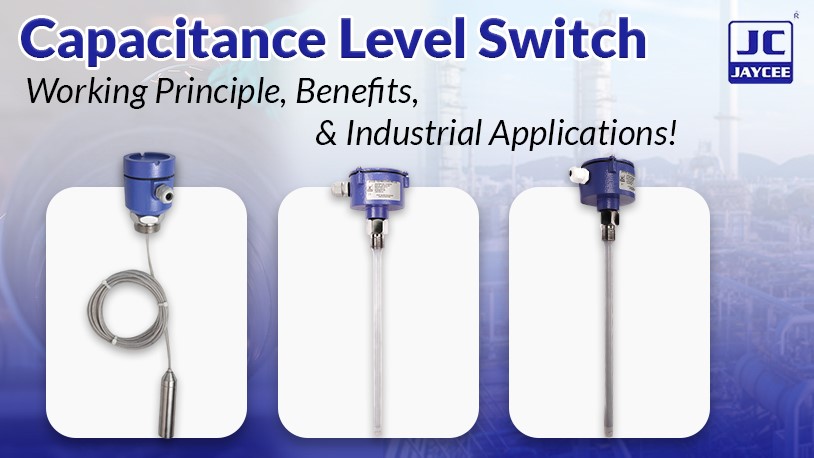
In modern industries, accurate level detection plays a vital role in ensuring safe and efficient operations. One widely used technology for level detection in tanks and containers is the Capacitance Level Switch. Known for its reliability and versatility, this device is suitable for liquids, powders, slurries, and granular materials across various industries.
This article explains the working principle, key benefits, and industrial applications of capacitance level switches in a simple, natural, and SEO-friendly format.
A capacitance level switch is an electronic device used to detect the presence or absence of material at a specific level in a tank, silo, or pipeline. It works by measuring changes in electrical capacitance caused by the presence of material near the sensor probe.
The switch triggers an alarm or control action when the material reaches the preset level, helping prevent overflow or dry running.
The operation is based on the concept of capacitance, which is the ability of a system to store an electric charge.
The change in capacitance indicates whether the material level has reached the sensor point.
They can detect liquids, powders, granules, slurries, and viscous materials.
Since there are no mechanical components, maintenance requirements are low.
Works well in dusty, sticky, or high-pressure environments.
Easy installation even in limited space tanks.
Provides consistent level detection with minimal false alarms.
Capacitance switches operate in high temperature and pressure environments.
Long operational life with low maintenance cost.
Capacitance level switches are widely used across industries.
Used for detecting levels of corrosive liquids, solvents, and chemicals.
Applied in storage tanks for milk, oil, syrups, and grains.
Helps monitor cement, fly ash, and powder levels in silos.
Used in hygienic applications requiring precise material handling.
Suitable for fuel, oil, and chemical storage tanks.
Helps monitor water and sludge levels.
Used in pellet and resin storage silos.
To achieve optimal performance, consider:
Correct selection ensures reliable long-term operation.
Proper installation improves performance and lifespan.
Industries prefer capacitance technology because it provides:
As industries continue automation upgrades, capacitance switches remain a dependable solution.
Modern capacitance switches now include:
These advancements improve plant safety and productivity.
A capacitance level switch is a dependable solution for accurate level detection across multiple industries. Its simple working principle, low maintenance requirement, and adaptability make it ideal for liquids and bulk solids alike.
Choosing the right capacitance level switch helps industries improve safety, reduce operational risks, and enhance process efficiency.
Looking for reliable Capacitance Level Switches or industrial level measurement solutions?
Jaycee Technologies offers high-quality products, expert support, and customized solutions for your industrial needs.
Contact our team today to discuss your application requirements and get the best solution for your process automation needs.
Silicone, EPDM, and Nitrile rubber are commonly used depending on temperature and chemical resistance.
Custom molds typically take around 2–4 weeks depending on complexity.
Yes, rubber-to-metal bonding is widely used in industrial components.
The required hardness depends on flexibility, load conditions, and environmental exposure.
