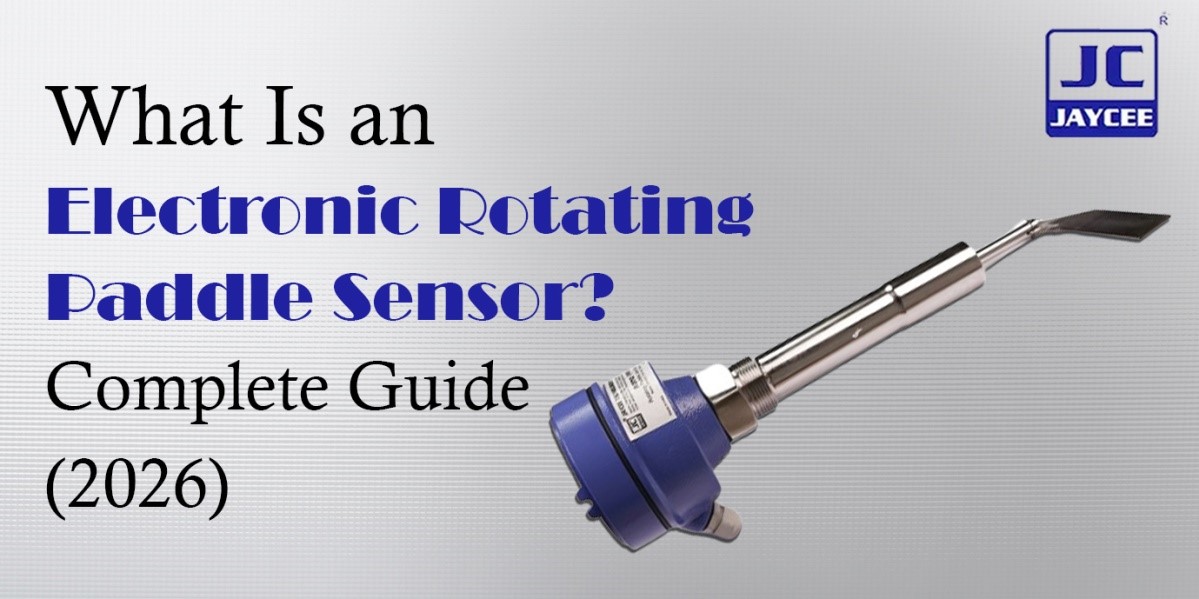
In the highly demanding industrial categories of 2026, the precise measurement of bulk solids, from fine powders to heavy gravel, is critical to avoid silo overflows and production stoppages. With the increasing integration of automation in the supply chain, the Electronic Rotating Paddle Sensor has proven to be the most effective "point level" technology for silos, hoppers, and bins.
For the plant operator and process engineer, dry material handling demands rugged and smart sensors. By choosing to implement sophisticated level control technology from a reputable expert such as Jaycee Tech, you can be assured that your storage system is running at maximum efficiency without the risk of material loss or equipment breakdown.
An electronic rotating paddle sensor is a point-level controller that is specifically designed for solid materials. Unlike the traditional mechanical switch, the 2026 electronic models use magnetic induction or electronic torque sensing, which is more reliable and frictionless. The main components of these intelligent sensors are:
To grasp why this technology is so ubiquitous in today’s silos, let’s walk through the process of how an electronic rotating paddle sensor works in a real-world industrial setting.
In an empty or partially filled silo, the motor of the sensor is free to rotate the paddle. In 2026 models of the sensor, this process is often tracked by a "heartbeat" LED, which shows that the sensor is working properly.
As the material level increases and reaches the paddle, it causes resistance.
The electronic circuit recognizes the torque rise when the paddle is stalled by the material. The motor is automatically de-energized to avoid overheating (extending the motor's life), and the signal is transmitted to the control room or PLC (Programmable Logic Controller) to stop the filling operation.
The material level falls below the paddle, and the resistance is released. The spring or magnetic reset mechanism is activated, and the motor turns on the rotation. The signal is switched back to "low," and the filling operation can continue.
The trend towards "Smart Factories" has completely changed the performance criteria for level switches.
An overfill is not only a nuisance, but it is also a safety risk and a huge loss of funds. The secondary safety feature of electronic sensors is unmatched by mechanical switches, ensuring 99.9% reliability in 2026.
The paddle sensor was prone to failure due to the leakage of dust from the motor shaft seal. The Jaycee Tech paddle sensor is designed with magnetic coupling, where the motor and the paddle are separated by a solid wall. The magnetic force propels the motion from the motor to the paddle, thus removing the most common point of failure.
In 2026, the cost of labor makes it inefficient to manually check the silo. Since the electronic paddle sensor has the ability to "self-diagnose" (ability to detect whether the motor has failed or the paddle is broken), the maintenance personnel will only act when the sensor requests them through the digital network.
While purchasing your level control system, make sure your vendor satisfies the following 2026 industrial requirements:
Jaycee Tech is a recognized leader in industrial automation and level sensing. Our precision technology is suited for high-volume bulk handling applications:
The Electronic Rotating Paddle Sensor is the unsung hero of the bulk solids industry. In 2026, where precision and automation are the name of the game for profitability, these sensors offer the reliability and ease of use that high-tech ultrasonic or radar sensors may not offer in dusty environments. By working with a dedicated specialist like Jaycee Tech, you can be assured that your material handling operations are protected by the best in level sensing technology.
No. Rotating paddle sensors are specifically designed for bulk solids. For liquids, ultrasonic or float-style sensors are more appropriate.
Unlike optical or ultrasonic sensors, rotating paddle sensors are virtually unaffected by dust clouds, making them the preferred choice for grain elevators and cement silos.
Most Jaycee Tech sensors are designed as "Fail-Safe." You can configure them to signal a "High Level" during a power loss to prevent accidental overfills.
Yes. While vertical mounting from the top of the silo is common for high-level alerts, they can also be mounted horizontally through the side wall for low-level or mid-level detection.
