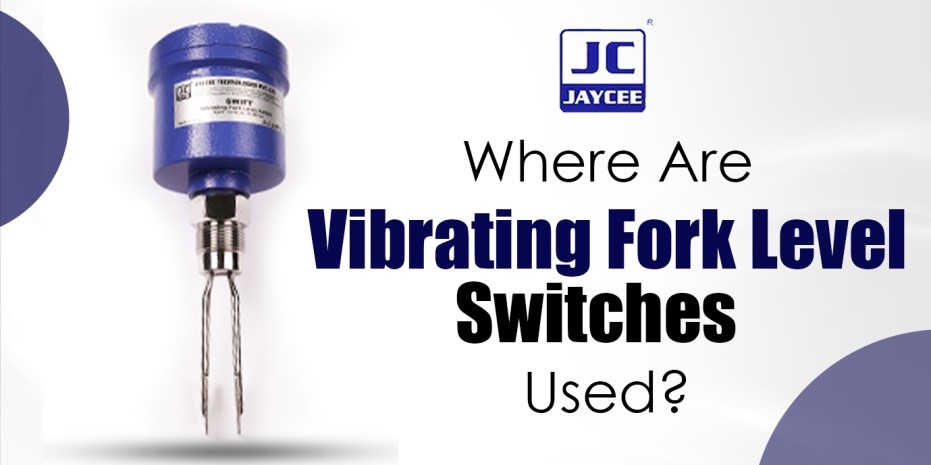
Vibrating fork level switches are used across the process industry — chemical plants, water and wastewater treatment, food and beverage production, oil and gas, power generation, pharmaceuticals, and bulk solids handling — anywhere operators need reliable point-level detection for liquids, slurries, powders, or granules. They're especially common for high/low alarms, pump protection, overfill prevention, and dry-run protection because they work regardless of pressure, temperature, foam, turbulence, or vapor in the vessel.
At Jaycee Tech, this is one of the questions we hear most from plant engineers evaluating point-level instrumentation, so here's a full breakdown of where — and why — vibrating fork switches get specified.
A piezoelectric crystal drives two tuning-fork-shaped prongs at their natural resonant frequency. When the fork is in air (or gas), it vibrates freely. When the surrounding material — liquid or bulk solid — covers the fork, the vibration is dampened and the frequency shifts. That shift triggers a switch output. No moving parts beyond the fork itself, no calibration required, and no sensitivity to dielectric constant, conductivity, foam, turbulence, or vapor — which is exactly why the technology shows up in so many different industries.
It operates using two vibrating fork tines that oscillate at a fixed frequency. When the fork comes into contact with a liquid, the vibration frequency changes. The electronics detect this change and switch the output, indicating the required level.
Because there are no moving mechanical parts, Vibrating Fork Level Switches offer high reliability, long service life, and minimal maintenance.
The right model depends on a handful of factors: media type (liquid vs. bulk solid), temperature and pressure rating, process connection size, hazardous-area certification needs, and hygienic requirements. Jaycee Tech supplies vibrating fork level switches engineered for liquid, slurry, and bulk-solid applications across these industries, with sanitary, hazardous-area, and standard industrial variants available.
If you're not sure which configuration fits your process, our team can help you match a switch to your tank geometry, media characteristics, and safety requirements — get in touch with Jaycee Tech's engineering team for a recommendation.
It's used for point-level detection — triggering an alarm or switching a relay when liquid, powder, or granular material reaches a specific level in a tank, hopper, pipe, or vessel. Typical uses include high-level alarms, low-level/dry-run protection, and overfill prevention.
Yes. Standard forks are designed for liquids and slurries, while a wider "paddle" style fork (sometimes called a vibrating rod or paddle switch) is built specifically for powders, granules, and bulk solids in silos and hoppers.
Yes — ATEX, IECEx, and FM/CSA-certified explosive-atmosphere versions are widely available and commonly used in oil and gas, chemical, and grain-handling facilities.
A float switch relies on buoyancy and moving mechanical parts, which can stick, foul, or wear out. A vibrating fork has no moving mechanical linkage, isn't affected by turbulence or foam, and generally requires less maintenance — making it the preferred choice in dirty, viscous, or agitated media.
No. They're factory-set and don't require calibration for changes in density, dielectric constant, or conductivity, which makes commissioning faster than with capacitive or conductivity-based switches.
Yes, within limits. The vibrating action helps prevent material buildup on the fork, and manufacturers publish maximum viscosity/density ratings — Jaycee Tech's engineering team can help match the right model to your specific media.
Consider the process liquid, operating temperature, pressure, mounting type, process connection, output signal, material compatibility, and environmental conditions before selecting a Vibrating Fork Level Switch.
Jaycee Technologies manufactures high-quality Vibrating Fork Level Switches with robust construction, accurate level detection, reliable performance, industry-specific solutions, and expert technical support for a wide range of industrial applications.
