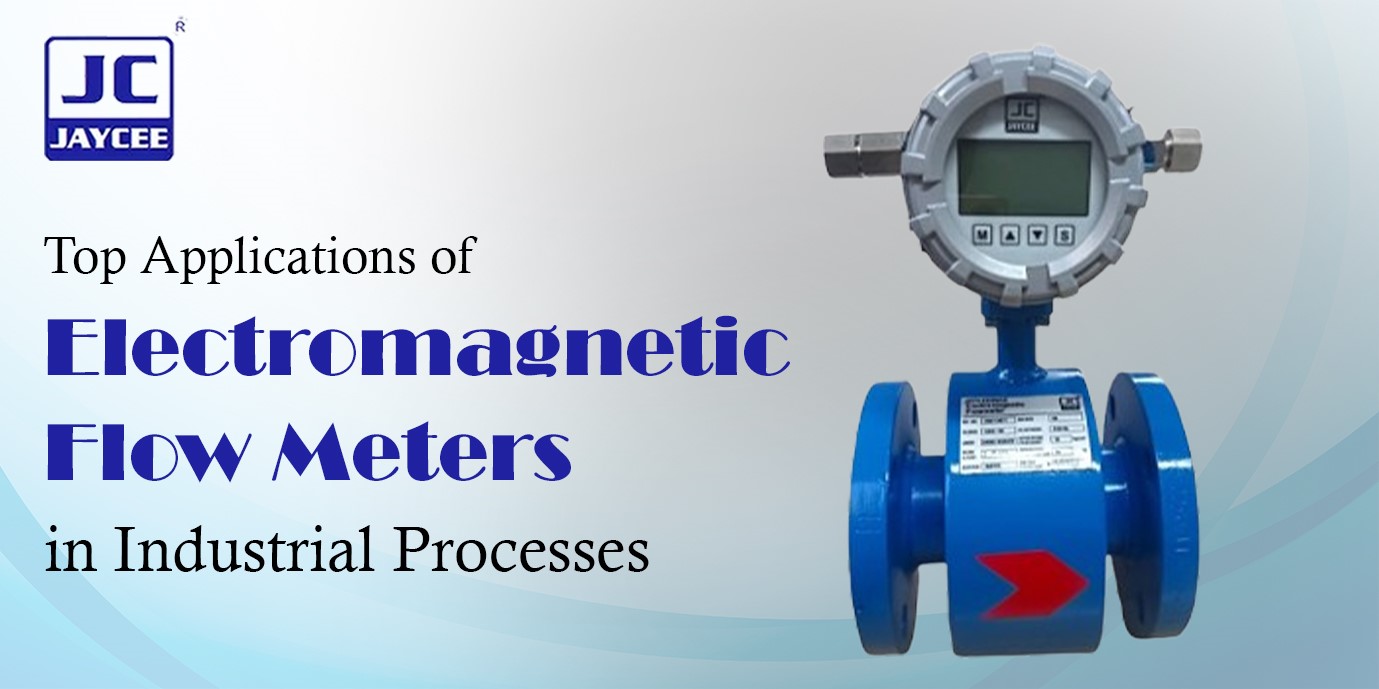
Accurate flow measurement is essential for maintaining efficiency, reducing operational costs, and ensuring product quality in industrial processes. Among the various technologies available today, Electromagnetic Flow Meters (Mag Flow Meters) have become one of the most reliable solutions for measuring conductive liquids.
Unlike mechanical flow meters, electromagnetic flow meters have no moving parts, making them highly durable, low-maintenance, and suitable for demanding industrial environments. Their ability to provide precise measurements with minimal pressure loss has made them a preferred choice in industries ranging from water treatment to food processing.
This comprehensive guide explains the top applications of electromagnetic flow meters, how they work, their advantages, limitations, and how to select the right meter for your industrial process.
An electromagnetic flow meter, also known as a magnetic flow meter or mag meter, is a device used to measure the flow rate of electrically conductive liquids.
It works using Faraday's Law of Electromagnetic Induction, which states that a voltage is generated when a conductive liquid flows through a magnetic field. This voltage is proportional to the flow velocity and is converted into an accurate flow measurement.
An electromagnetic flow meter is a flow measurement device that accurately measures the volumetric flow rate of conductive liquids by applying Faraday's Law of Electromagnetic Induction without using moving mechanical components.
The working process involves four simple steps:
Because there are no moving parts, the measurement remains stable even after years of operation.
Industrial facilities choose electromagnetic flow meters because they offer several operational advantages.
Key BenefitsThese advantages help industries reduce downtime while improving production efficiency.
Water treatment facilities require accurate flow measurement at every stage.
Common ApplicationsMunicipal water authorities use electromagnetic flow meters to monitor treated water supplied to residential and commercial areas.
Wastewater often contains sludge, suspended solids, and chemicals.
Since electromagnetic flow meters have no obstructions inside the pipe, they perform exceptionally well in these demanding conditions.
ApplicationsChemical manufacturing demands high precision because incorrect flow measurements can affect product quality and safety.
Common FluidsFor aggressive chemicals, selecting the correct liner material (PTFE, PFA, or rubber) significantly increases meter life and measurement reliability.
Food manufacturers require hygienic and highly accurate flow measurement.
Electromagnetic flow meters are commonly used because sanitary designs comply with food safety standards.
ApplicationsThe pharmaceutical sector depends on highly accurate liquid measurement during production.
ApplicationsPulp processing involves thick slurries that are difficult for many flow meter technologies.
Electromagnetic flow meters easily measure these challenging fluids.
ApplicationsMining operations transport abrasive slurry over long distances.
Electromagnetic flow meters provide accurate measurements without internal moving components that wear quickly.
ApplicationsPower plants rely on accurate flow monitoring for efficient energy production.
ApplicationsModern agriculture increasingly uses automated irrigation systems.
Electromagnetic flow meters help farmers monitor water usage accurately.
ApplicationsCommercial buildings use electromagnetic flow meters to monitor chilled and hot water circulation.
Applications| Industry | Typical Liquid | Why Electromagnetic Flow Meter? |
|---|---|---|
| Water Treatment | Clean Water | High accuracy |
| Wastewater | Sludge | Handles solids |
| Chemical | Acids & Alkalis | Corrosion resistance |
| Food | Milk & Juice | Hygienic design |
| Pharmaceutical | Purified Water | High precision |
| Mining | Slurry | Abrasion resistance |
| Power Plant | Cooling Water | Reliable operation |
| Agriculture | Irrigation Water | Water conservation |
| HVAC | Chilled Water | Energy monitoring |
| Pulp & Paper | Pulp Slurry | Measures thick fluids |
Industry reports indicate that:
These trends highlight the growing importance of electromagnetic flow meters in modern industrial operations.
Before purchasing, evaluate the following factors.
Although highly reliable, electromagnetic flow meters have certain limitations.
They cannot measure:
These fluids lack sufficient electrical conductivity.
Proper grounding and installation are also essential to ensure accurate measurements.
Industrial flow measurement is evolving rapidly.
Emerging innovations include:
These technologies help industries improve uptime, optimize maintenance schedules, and make data-driven operational decisions.
They measure electrically conductive liquids such as water, wastewater, acids, alkalis, slurries, milk, juice, chemicals, and pulp.
No. Oil is generally non-conductive, making it unsuitable for electromagnetic flow measurement.
Because they accurately measure dirty liquids, sludge, and fluids containing suspended solids without clogging.
Yes. High-quality electromagnetic flow meters typically achieve accuracy between ±0.2% and ±0.5%, depending on the model and installation conditions.
Very little. Since there are no moving mechanical parts, maintenance requirements are significantly lower than many traditional flow meter technologies.
Major industries include:
Electromagnetic flow meters have become one of the most dependable technologies for industrial liquid flow measurement. Their high accuracy, durability, and ability to measure conductive liquids without moving parts make them an ideal solution for a wide range of applications.
From municipal water treatment plants and chemical manufacturing facilities to food processing, pharmaceuticals, mining, and power generation, electromagnetic flow meters help organizations improve efficiency, reduce maintenance costs, and maintain consistent product quality.
As Industry 4.0 and Industrial IoT continue to transform manufacturing, modern electromagnetic flow meters equipped with digital communication and predictive diagnostics will play an even greater role in optimizing industrial processes.
Looking for a reliable Electromagnetic Flow Meter for your industrial application? Our experts can help you select the right model based on your process fluid, pipe size, operating conditions, and automation requirements. Contact us today for personalized guidance, technical support, and high-performance flow measurement solutions that improve efficiency and reduce operational costs.
